Showing posts with label Moon Landings. Show all posts

Monday, 21 December 2009

NASA Ames Looks back on 2009, Forward into 2010

Finding water on the moon, initiating a search for Earth-size planets, the 40th anniversary of the Apollo 11 moon landing and a new federal government cloud computing initiative were among the top stories for NASA Ames Research Center in 2009, which has just published its review of the year online and outlined some of its plans for 2010.

Lunar Impactor Launched, Finds Water on Moon

NASA successfully launched the Lunar CRater Observation and Sensing Satellite, or LCROSS, in June on a mission to search for water ice in a permanently shadowed crater at the moon’s south pole. The satellite lifted off on an Atlas V rocket from Cape Canaveral Air Force Station, Florida, along with a companion mission, the Lunar Reconnaissance Orbiter, or LRO. Preliminary data from LCROSS indicated the mission successfully uncovered water in a permanently shadowed lunar crater when it impacted the moon in October.

The discovery of water by LCROSS opened a new chapter in our understanding of the moon.

Kepler Mission Begins Search for Planets Like Earth
NASA’s Kepler spacecraft launched in March to begin its search for other Earth-like worlds. The mission will spend the next three years staring at more than 150,000 stars for telltale signs of planets. In August, the Kepler space telescope detected the atmosphere of a known giant gas planet, demonstrating the telescope’s extraordinary scientific capabilities.
Needless to say, the search for alien life remains one of the most exciting aspects of space exploration for all of here at Ex Astris.
More info at: http://kepler.nasa.gov

NASA Ames Celebrates 70th Anniversary
This year, NASA Ames is celebrating its 70th anniversary. Among the 10 activities held to commemorate the center’s 20th December 1939 anniversary, was a display of Ames historical exhibits in downtown Mountain View, California, and an aerial photo taken of Ames employees forming a “70″ on the airfield, and the launch of a new historical website.

New Cloud Computing Initiative Announced

Federal Chief Information Officer Vivek Kundra announced a new government cloud computing initiative in September at NASA Ames. Kundra unveiled the new Apps.gov platform, an online storefront for federal agencies to browse and purchase cloud-based information technology (IT) services and predicted it would significantly lower government costs and increase innovation.

NASA Breaks Ground for ‘Greenest’ Federal Building Ever

In August, NASA held a ceremonial groundbreaking and dedication event for what is expected to become the highest-performing building in the federal government. The new, environmentally friendly building at NASA’s Ames will be named ‘Sustainability Base’ in honour of the first humans to walk on the surface of another world from their Tranquility Base Apollo 11 lunar landing site 40 years ago.

International Space University, Singularity University Host Programs at NASA Ames
Also this past summer, Ames hosted the International Space University’s nine-week course for postgraduate students and young professionals from more than 40 countries. Nearly 200 students, along with dozens of faculty and guest lecturers, attended the university’s 22nd annual Space Studies Program, held for the first time ever at a NASA center. Simultaneously, Ames also hosted the newly-launched Singularity University’s graduate studies program, a nine-week graduate-level interdisciplinary curriculum designed to prepare the next generation of leaders to address “humanity’s grand challenges.”

NASA Ames Celebrates 40th Anniversary of Moon Landings
40 years ago, humans took their first steps on the moon. In commemoration of that historic event, NASA Ames hosted ‘Moonfest 2009: From Apollo to LCROSS, and Beyond!,’ a celebration of all things related to the moon. Held in July, the celebration focused on the 40th anniversary of the Apollo 11 moonwalks and NASA’s LCROSS mission. The day was filled with guest speakers, musical performances and hands-on family activities, interactive games and exhibits. More than 11,400 people attended the celebration at Ames.
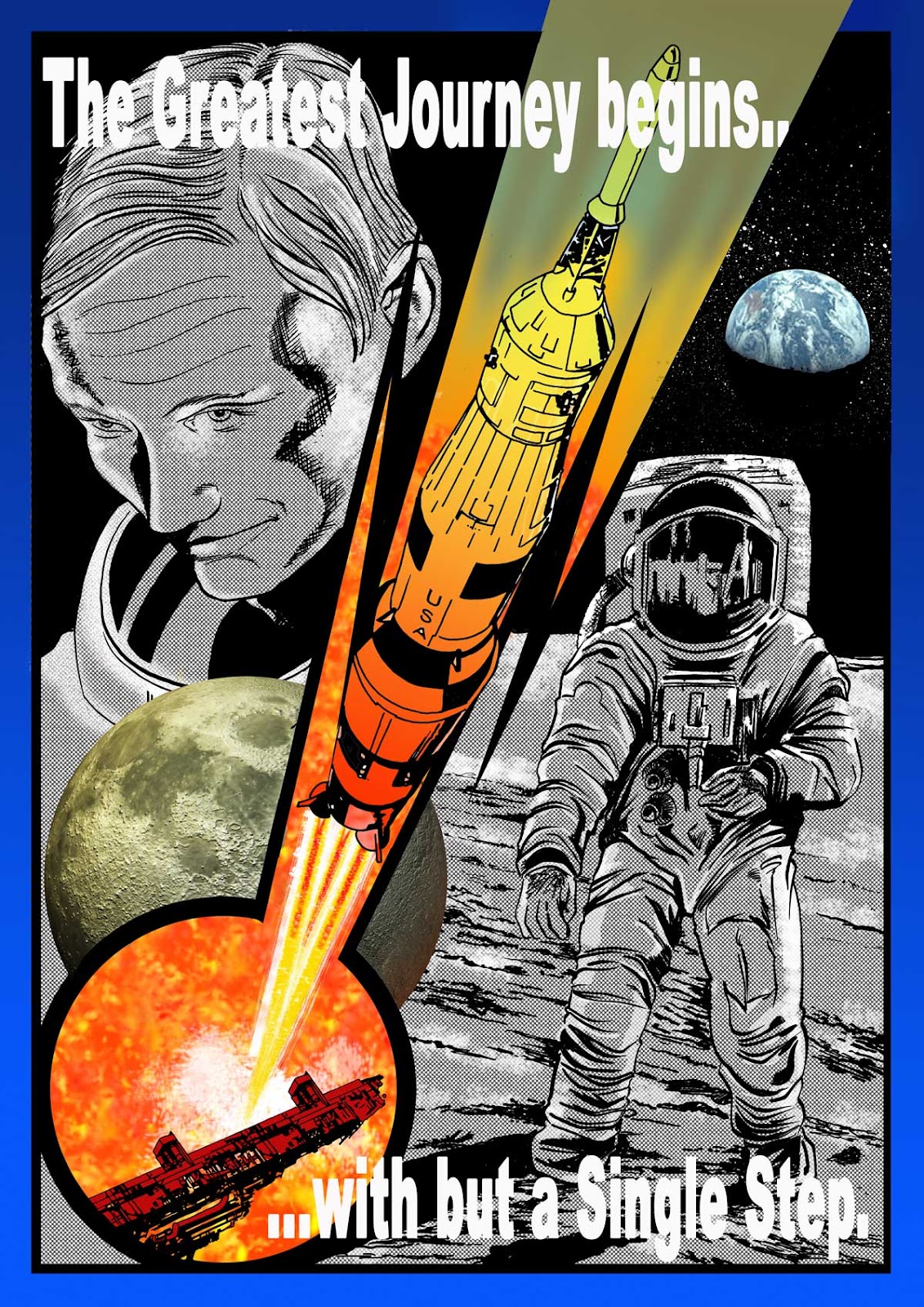
Ex Astris fans will recall we celebrated the event with a contribution to the downthetubes Moon Landing album (above), which you can view online here.

Ames Wins 2008 NASA Government Invention of the Year Award
NASA Ames was named the recipient of the 2008 NASA Government Invention of the Year Award this year. Ames won the award for developing a “High Speed Three-Dimensional Laser Scanner with Real Time Processing.” The scanner is used in a Mold Impression Laser Tool (MILT), a hand-held instrument used to scan space shuttle tiles to detect and measure the amount of any damage. Several MILT instruments are currently in use at NASA’s Kennedy Space Center, Florida, where they provide accurate and reliable tile flaw information for the space shuttle maintenance crews. In addition, MILT technology been adapted for use in other NASA programs, including the Orion Crew Exploration Vehicle (CEV), the Stardust Sample Return Capsule Program, and the Mars and Lunar Rover Programs.

NASA Successfully Launches PharmaSat, SOAREX Missions
NASA successfully launched its PharmaSat nanosatellite in May from NASA’s Wallops Flight Facility and the Mid-Atlantic Regional Spaceport located at Wallops Island, Va. PharmaSat investigated the effects of antifungal agents on the growth of yeast in microgravity. This research could improve understanding of how microbes may become resistant to the drugs used to treat sick astronauts on long-duration space missions. NASA also successfully launched two Sub-Orbital Aerodynamic Re-entry Experiments, or SOAREX, probes more than 80 miles high in 2009 from NASA’s Wallops. The two NASA-developed experiments will help engineers and scientists design efficient ways to return experiments to Earth from the International Space Station.

NASA, Google, Microsoft, Cisco Collaborate on Virtual Exploration, Climate Change
In commemoration of the 40th anniversary of Apollo 11, NASA and Google launched the Moon in Google Earth, an interactive, 3D atlas of the moon that enables users to explore a virtual moonscape and follow guided tours from astronauts Buzz Aldrin and Jack Schmidt.

Also in 2009, NASA and Google launched a new Mars mode in Google Earth that brings to everyone’s desktop a high-resolution, three-dimensional view of the Red Planet.
NASA and Microsoft Corp., announced this year they are jointly developing the technology and infrastructure necessary to make the most interesting NASA content, including high-resolution scientific images and data from Mars and the moon, available on WorldWide Telescope, Microsoft’s online virtual telescope for exploring the universe. Under the terms of a Space Act Agreement, NASA is processing enough data to fill 20,000 DVDs.

In 2009, NASA and Cisco Inc., partnered to develop an online collaborative global monitoring platform called the “Planetary Skin” to capture, collect, analyze and report data from satellite, airborne, sea- and land-based sensors on environmental conditions around the world. This data will be made available for the general public, government and businesses to measure, report and verify environmental data in near-real time to help detect and adapt to global climate change.

The Year Ahead…
Looking ahead to 2010, NASA Ames will continue to play a major role to support the space shuttle program with its work in thermal protection systems and the heat shields that protect the space shuttle during its fiery re-entry to Earth’s atmosphere. Public viewing opportunities of four live broadcasts of space shuttle launches drew nearly 500 people to Ames and will continue in 2010.

The Kepler mission, NASA’s first mission capable of finding Earth-size and smaller planets, will announce its latest discoveries in its search for habitable planets next year and the LCROSS mission will announce the latest results of its analysis of water it found at one of the lunar poles. The data will provide scientists with a wealth of data that will tell us a great deal about the lunar surface and help prepare NASA to put boots on the moon by the end of the next decade.

Also next year, NASA’s airborne observatory, SOFIA, is scheduled to begin conducting science flights.

New initiatives in 2010 will set the stage for a robust year in education and outreach.

“Educate to Innovate,” a federal challenge to improve education and NASA’s Summer of Innovation aspire to reach one million students through enrichment programs to keep kids on track and inspire the next generation of explorers.

• For more information about NASA Ames, visit: www.nasa.gov/centers/ames/news

• For information about NASA and agency programs, visit: www.nasa.gov

Tuesday, 21 July 2009

Exploring the Moon using Google Earth


Marking the anniversary of the first human moon landing, Google has launched Moon in Google Earth, an interactive, 3D atlas of the Moon, viewable with Google Earth 5.0.
Users can explore a virtual Moonscape, follow guided tours from Apollo 11 astronaut Buzz Aldrin and Apollo 17‘s Jack Schmitt, see the latest rover concepts by teams competing in the Google Lunar X-Prize, view high-resolution panoramic photos, watch previously unreleased video footage captured from the lunar surface, and much more.Moon in Google Earth also incorporates a complete lunar terrain data-set by Kaguya LALT, produced by JAXA/NAOJ, which serves as the atlas’ base-map.

It’s all very slick and great fun to use, although we’re disappointed Google hasn’t slipped in a few aliens for the SF fans. Perhaps next April 1st…

“40 years ago, two human beings walked on the Moon. Starting today, with Moon in Google Earth, it’s now possible for anyone to follow in their footsteps,” said Moon in Google Earth Product Manager, Michael Weiss-Malik. “We’re giving hundreds of millions of people around the world unprecedented access to an interactive 3D presentation of the Apollo missions.”

The most recent tool to have been developed as a result of the Space Act Agreement between Google and NASA, Moon in Google Earth enables information about the Moon to be accessible to anyone in a unique three-dimensional context.

In addition to satellite imagery and terrain, the following layers can be explored with Moon in Google Earth:

• Featured Satellite Imagery – Explore overlaid satellite imagery and detailed descriptions of selected areas on the Moon from Arizona State University’s ‘Lunar Image of the Week’
 
• Spacecraft Imagery – View selected imagery captured by the Apollo Metric Camera, Clementine, and the Lunar Orbiter
 
• Apollo Missions – Travel back to the Apollo era and discover the landing sites of Apollo missions 11-17. Explore “Street View”–style panoramic images, watch previously unreleased footage from Spacecraft films, and read about the places astronauts saw on their trips to the Moon.
 
• Guided Tours – Take a narrated tour of the Moon from Apollo astronauts Buzz Aldrin (Apollo 11) and Jack Schmitt (Apollo 17)
 
• Historic Maps – Discover Apollo-era geologic and topographic maps of the Moon that were used in mission control for trips to the Moon
 
• Human Artifacts – Learn about the various types of exploratory equipment that humans have left on the Moon and where those objects can be found today. Artifacts from the United States, the Soviet Union, China, the EU, Japan, and India are included, some of them as 3D models.

• To experience Moon in Google Earth, open Google Earth 5.0 and switch modes from ‘Earth’ to ‘Moon’ on the top toolbar. Google Earth 5.0 can be downloaded at http://earth.google.com/moon.

Friday, 17 July 2009

Was Apollo just a stunt?

Top Brit SF author Charles Stross has offered a fascinating opinion on the first Moon Landing on his blog, noting the reason why there isn’t a moon colony and why NASA didn’t continue the Apollo missions was because it was a stunt.“The real mission wasn’t to go to the moon,” the author of cracking SF novels such as Accelerando, Halting State and Saturn’s Children argues.

“It was to bring two astronauts and 100Kg of moon rocks back from the lunar surface and into lunar orbit (to rendezvous with the CSM stack for the journey home) — and it took a 3000 ton behemoth to accomplish this. Launching a bigger, more useful LEM (one that could carry 3 or 4 astronauts to the lunar surface, along with a decent-sized rover and supplies for a couple of weeks) would have added tonnes to the LEM payload … and hundreds, if not thousands of tons to the launch stack. With cost scaling as the cube of the vehicle mass, you don’t need to be an accountant to realize that the US government, stuck fighting a war in South East Asia, wasn’t going to give NASA the money to build in even one kilogram more of payload than was strictly necessary… The per-launch cost of even a minimal Apollo moon shot was $431M, in 1967 dollars — call that $5-10Bn today.”
His article is a fascinating read, also asking the obvious: could NASA go back to the Moon today?

“I want to believe,” says Stross. “But… Today we lack a vital resource that both Wernher von Braun and Sergei Korolev took for granted: thousands of engineers with the experience of designing, building, and launching new types of rocket in a matter of years or even months. We used to have them, but some time in the past 40 years they all retired.

“We’ve got the institutions and the data and the better technology, but we don’t have the experience those early pioneers had. And I’m betting that the process of rebuilding all that institutional competence is going to run over budget.

While NASA’s Constellation program might work, and while it could deliver far more valuable lunar science than Apollo ever did, it will inevitably cost much more than NASA’s official estimates suggest, because it’s too big a project for today’s NASA — NASA, and indeed the entire space industrial sector in the USA, would have to grow, structurally, to make it work.”

Read the full article — we’ve paraphrased a lot — read his blog…

Wednesday, 15 July 2009

ITV1 Marks Moon Landing with ‘Moonshot’ Doc


ITV1 broadcasts Moonshot, a powerful new documentary charting next Monday (20th July), marking the anniversary of the Apollo 11 mission to the moon back in 1969.Starring Hotel Babylon‘s Daniel Lapaine as Neil Armstrong, James Marsters (well known for his roles in Buffy the Vampire Slayer, and Smallville) as Buzz Aldrin and Afterlife‘s Andrew Lincoln as Michael Collins, this drama documentary weaves the story of the men who undertook the mission with HD Nasa footage of Apollo 11 to bring together a unique testimony of this historic event.

The documentary, a co-production between ITV and indie producers Dangerous and other partners is written by Tony Basgallop, (Hotel Babylon), and directed by Richard Dale, (Diana: The Last Days of a Princess, 9/11: The Twin Towers).

Moonshot is the compelling story of the moment that united 600 million people around the world in 1969, dramatising key moments and events in the years spent preparing for their mission. The film builds a picture of the astronauts’ lives on the ground and how they shaped what happened in space and on the moon.

In 1961 President Kennedy told the world that that the United States would land on the moon by the end of the decade. This began the series of Apollo missions that would culminate with Apollo 11 – the first moon landing, one of the most watched events ever.
Moonshot follows the astronauts as they go through NASA’s intense selection procedures and reveals the arduous Apollo training process that has such an impact on their families and friendships.

Along with other key moments, the film captures the deliberations involved in selecting the crew. In one scene, the NASA official leading the process tells Neil Armstrong that Buzz Aldrin has a reputation for speaking his mind. He gives Neil a choice between Aldrin and fellow astronaut Jim Lovell, forcing him to think about who he would be able to work with – and who he could trust with his life. Armstrong chooses Aldrin, but which of them would take the first steps on the moon would be decided by NASA.

NASA discusses the merits of the two men, acknowledging that the first man on the moon would be a hero and would shoulder the responsibility for the rest of his life.

One of the officials says: “Neil’s calm, quiet, resolute – Neil’s what it says on the label. Buzz is … well you never know what you’re going to get from one day to the next.”

Another responds by saying: “Buzz wants it more.”

Prompting the reply: “Which is a reason not to give it to him.”

The decision goes in favour of Armstrong.

Also revealed is the strain of the mission, which causes tension between Aldrin and Armstrong when a simulated moon landing practice goes wrong – meaning in a real situation they would have crashed, and, later, before the launch, the families have to come to terms with the fact that the astronauts might not come back if things go wrong.


Included is a powerful scene where Armstrong shows his wife the message that will go out to the public if they fail to take off from the moon. It reads: ‘Fate has ordained that the men who went to the moon to explore in peace will stay on the moon to rest in peace. These brave men Neil Armstrong and Edwin Aldrin know that there is no hope for their recovery.’
Stunned, she asks Neil if this is the first she would hear of it. He tells her that she will get a call from the President if anything happens. She says: “Nixon? Nixon will call me? Wow. I hope he doesn’t.”

After a successful launch Apollo 11 became a huge media story around the world. The Pope asked for a colour television to be installed in his summer residence, while West Germany announced they were calling the day of the landing ‘Apollo Day’ and schoolchildren in Bavaria were given the day off. The world held its collective breath as the lunar module approached the moon… and breathed a sigh of relief as it touched down safely on 20th July 1969. Then Armstrong said the famous words, “Houston, Tranquility Base here. The Eagle has landed.”


After a succesful mission and return to Earth, Apollo 11 splashed down safely on Earth the famous American newscaster Walter Kronkite said: “The date is now indelible. It is going to be remembered as long as man survives – July 20 1969 the day man reached and walked on the moon.”

Moonshot is bound to prompt many memories from those who were alive to witnes the dramatic events, and, hopefully, give those too young to remember the dramatic time a taste of how exciting space exploration once was – and, if humankind does return to the moon in 2020, will be again…


Moonshot screens at 10.50pm on Monday 20 July on ITV1. It will also be shown by the History Channel.

Apollo Landing Celebrations Mount Up

With excitement building as we near the 40th Anniversary of the first human Moon Landing, it’s no surprise that there are plenty of events and media happenings being lined up to mark the occasion.

Over on my main downthetubes forum, for example, we have a Moon Landing 40th Anniversary: A Comics Celebration" – a gallery of illustrations and comic art inspired by the Apollo expedition and space exploration. In addition to the one page “Return to the Moon” strip, so far we have art from the likes of Andrew Cheverton, Bob Bello, Ian Duerden, Martin Baines and many others. Check it out if you have time, there’s some smashing work on display.

In the UK both the BBC and ITV have been screening a range of programmes: I enjoyed “In Search of Neil Armstrong” last week and will be checking out ITV’s “Moonshot” next Monday night, although goodness only knows why they have decided to put it on so late, after the news.

I’ve also spotted a reprint of the Daily Mirror for 21 July or thereabouts in WH Smiths, complete with DVD of footage of the Apollo landing: it will be interesting to see what Garth was up to (and The Perishers!) on that momentous day in 1969…

The British Film Institute’s “One Giant Leap” season in London continues this coming week with screenings of the films 2001: A Space Odyssey, Countdown and Moonwalk One, the premiere of newly remastered Director’s Cut in high definition of Theo Kamecke’s film, commissioned by NASA to cover their historic Apollo 11 moonshot. With an atmospheric original score by Charles Morrow and a moody narration by Laurence Luckinbill, Kamecke’s documentary has been described as perhaps the most significant time-capsule record of Apollo 11 ever made.

Finally for this round up, while it won’t be out until November, the Oscar nominated documentary about the Apollo missions, For All Mankind, is set for both DVD and Blu-Ray release.

During the Apollo lunar missions from 1968 to 1972, those onboard were given 16mm cameras and told to film anything and everything they could, in space, in orbit, and on the surface of the moon itself. Two decades later, filmmaker Al Reinert went into the NASA vaults to create this extraordinary compendium of their journeys and experiences.

Assembled from hundreds of hours of the astronauts’ own footage, with a soundtrack made up of their memories and a specially composed score by Brian Eno, the film takes the form of one journey to the moon and back again, building with elegant simplicity and exquisite construction to create an overpowering vision of human endeavour and miraculous experience.

At once intimate and awe-inspiring, For All Mankind is a genuinely mesmerising first-hand document of one of the high points of the 20th century. Released as part of The Masters of Cinema Series, Criterion’s beautiful high-definition restoration of the film will be a comprehensive, director-approved special edition.

The release will include a new, restored high-definition transfer, supervised and approved by director Al Reinert; audio commentary featuring Reinert and Apollo 17 commander Eugene A. Cernan, the last man to set foot on the moon; a gallery of Apollo 12 and Skylab astronaut Alan Bean’s artwork, inspired by his life as an astronaut, with commentary and a filmed introduction; and a special booklet, featuring essays, credits, stills, a new interview with Brian Eno, and more.

DVD Catalogue No: EKA40313
DVD Barcode: 5060000403138
DVD RRP: £19.99
Blu-ray Catalogue No: EKA70011
Blu-ray Barcode: 5060000700114
Blu-ray RRP: £24.99
Release Date: 16 November 2009
Certificate: Exempt
Running Time: 79 minutes approx.
Format: Colour
Genre: Documentary
Director: Al Reinert

Thursday, 2 July 2009

Ex Astris Artist Celebrates Moon Landings

bill_storie_moonlanding.jpg


Mike Nicoll has just sent me this fab piece of art to celebrate the 40th anniversary of the first human moon landing, which forms part of a gallery of art marking the event over on thedownthetubes forum.

Several artists have contributed images so far, including Doctor Who illustrator Colin Howard, Space Age Magazine editor Bob Bello and the Etherington Brothers.

More contributions are welcome.

If you're a fan of Mike's art, you may be interested to know we have four Ex Astris wallpapers for PCs available as free downloads over on the revamped web site: www.exastris.co.uk. After being a simple "redirect" for a couple of years, we've just launched the site proper and more on the strip and regularly updated strip posts are to feature soon.